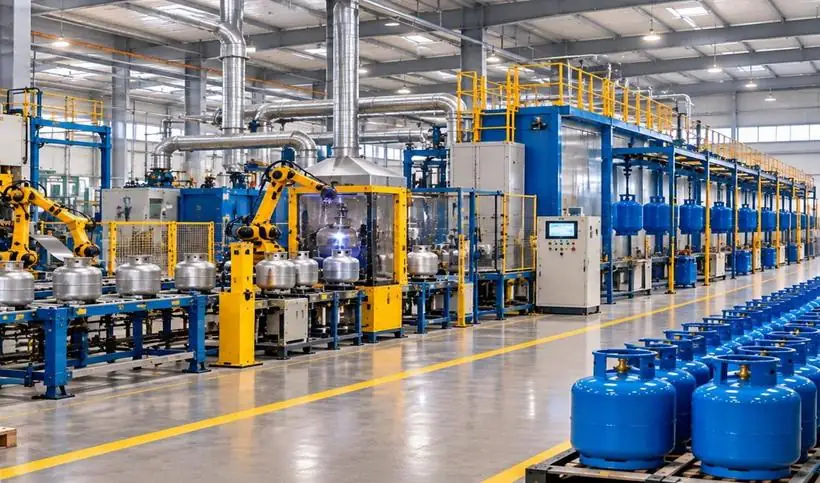
LPG cylinder production line
Standards-compliant. Traceable. EPC+F-ready.Modular LPG cylinder production lines from sheet preparation to final assembly, 100–600+ cylinders per hour.
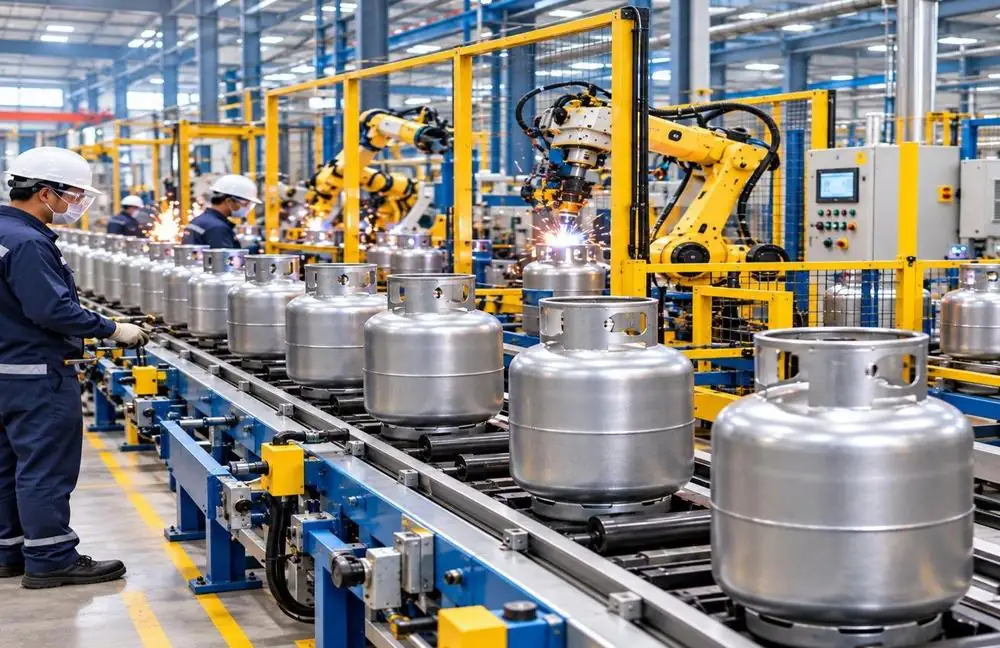
Modular production line for safe, standards-compliant and fully traceable LPG cylinders
Water capacity range
Typical product range
Cylinders per hour
Production capacity
Product families
2 / 3 / 9 / 12 / 19 kg domestic and 45–50 kg commercial
Delivery approach
EPC and commissioning
Line architecture
Semi-automatic, automatic or high-capacity configuration.
Full traceability
Material certificates, WPS/PQR, test records and serial numbers.
Modular design
New investment or modernisation of an existing facility.
Designed to the mandatory LPG pressure-vessel standard of the target market

ISO 22991
Material, design, construction, workmanship and production testing for transportable refillable welded steel LPG cylinders.

EN 1442
Widely used reference standard for welded, refillable LPG cylinders in the European market.

DOT / national codes
In the US and other markets, acceptance criteria, lot testing, marking and certification depend on the national authority.
Product drawings and calculations
Volume, diameter, sheet thickness, test pressure, tare weight
Welding quality package
WPS, PQR, WPQ, NDT procedures, sampling and lot plan
Material and traceability
Mill certificate, heat number, serial number, valve compatibility
Compliance
Country regulation, third-party inspection, type testing, FAT
Compliance path: code compliance → type testing → QA/QC records → market approval. Final design and test pressures are confirmed per country regulations, product size and approval body.
Controlled flow from material receiving to dispatch on a single integrated line
Sheet cutting
Coil / plate preparation, blanking
Deep drawing
Upper / lower half-shell forming
Trim and piercing
Neck, valve boss and edge preparation
Welding
Body, foot ring, valve guard
Heat treatment
Normalising / stress relief
Hydro test
Pressure resistance and leak control
Surface preparation
Shot blasting, cleaning
Painting and final
Powder coating, curing, marking
Control gates: material certificate → welding / NDT → heat-treatment records → hydrostatic test → final inspection.
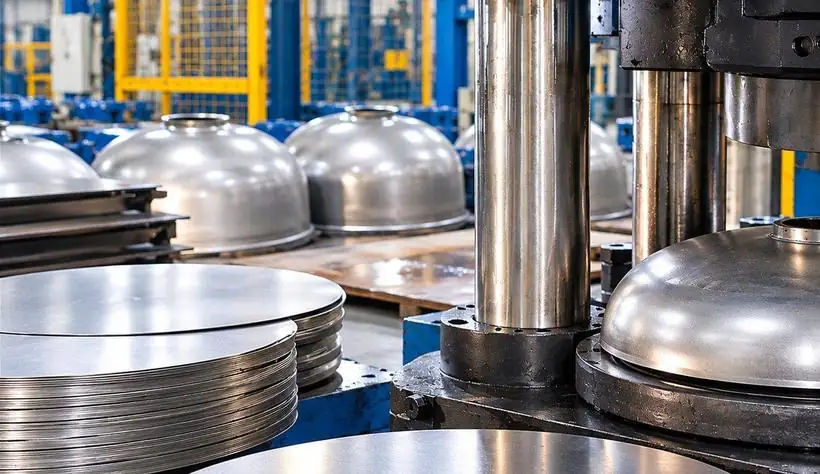
Sheet preparation and production of the two half-shells
Objective
Produce the two half-shells with dimensional accuracy and minimum scrap. Scrap rate is optimised through nesting, sheet quality and press-tool design.
Forming and inspection
Hydraulic deep drawing of upper and lower cups; trimming, edge curling, punching and neck-hole preparation. Inspection of diameter, height, neck axis and form tolerance.
Critical investment item
Press tonnage, die set, automation level and product diameter directly determine line capacity and product-family flexibility.
Core process for pressure integrity: automation, fixture accuracy and QA/QC documentation
Body joining
Upper/lower cup alignment, circumferential welding, seam tracking and fixturing.
Accessory assembly
Valve boss, foot ring, collar / valve guard, handle and protection elements.
Welding quality
WPS/PQR/WPQ, parameter records, visual inspection, sample tests and NDT plan.
Line integration
Conveyors, turntables, robotic or automatic welding stations and buffer areas.
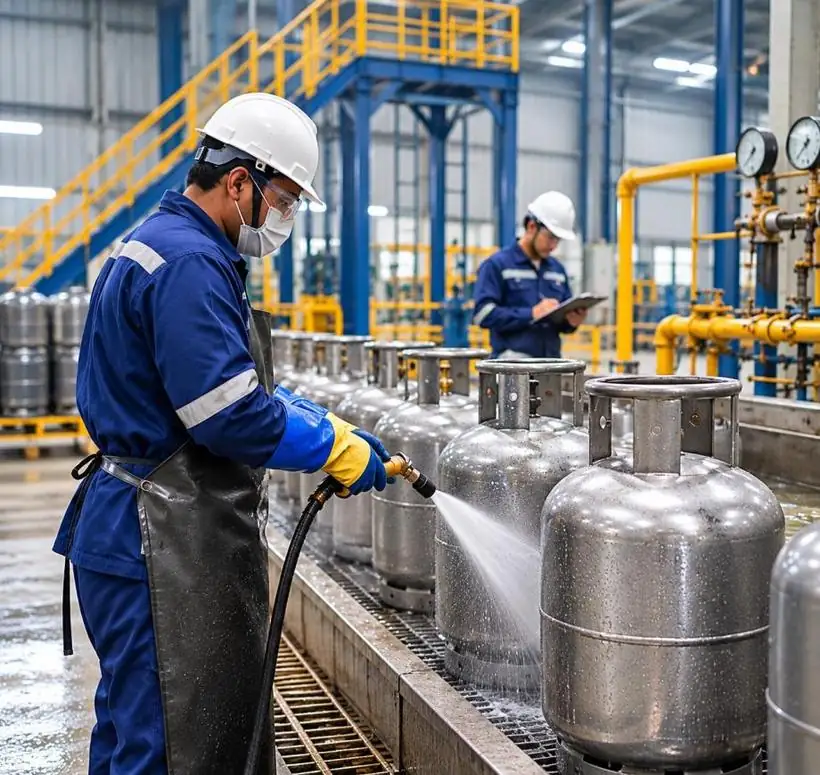
Minimum control logic: fit-up check · weld records · lot sampling · reject procedure.
Post-production verification chain for pressure-vessel safety

Heat treatment furnace
Post-weld stress relief / normalising; furnace temperature records and batch traceability.

Hydrostatic test
Pressurisation with water, holding time, deformation / leakage control and test records.

Leak test
Pneumatic / air leak test, valve-area and weld-seam verification.

Final safety gate
Rejected-cylinder segregation, re-test procedure, marking and QA release.
Safety gate: no cylinder is released without heat-treatment records, a passed hydrostatic test and leak verification.
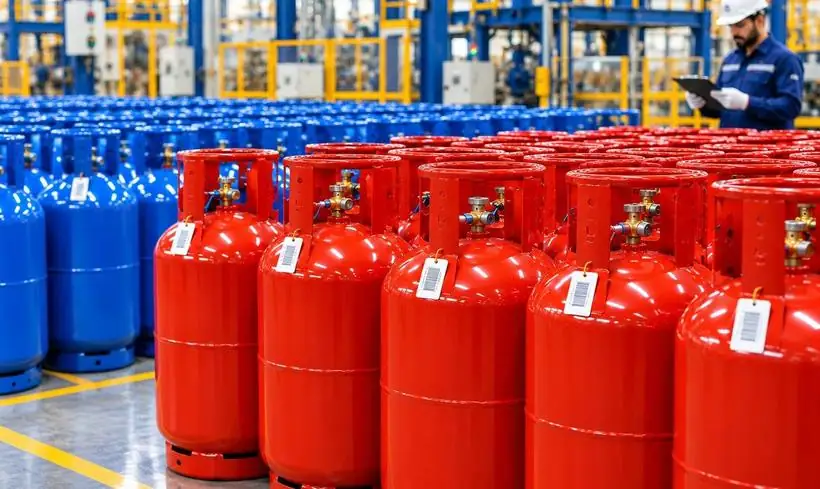
Surface preparation and the coating system define service life and brand quality

Shot blasting
Scale, burr and oxide removal; profile for coating adhesion.

Powder / wet paint
Electrostatic powder coating or wet paint; customer RAL code.

Curing oven
Paint curing with temperature and time control records.

Final assembly
Valve fitting, tare weight, logo / barcode, final inspection.
Options: overhead conveyor · paint recovery · oven heat recovery · inline barcode / RFID · automatic weighing.
Turnkey scope matrix from sheet input to dispatch

Sheet preparation
Decoiler, straightener, blanking press / circle cutting; coil or plate feeding option

Forming
Hydraulic deep drawing press, trimming and punching; die sets per product diameter

Welding
Circumferential, boss / foot ring / guard welding; automatic or robotic option

Heat treatment
Continuous / batch furnace, cooling conveyor; temperature recording required

Test
Hydrostatic testing, air leak testing, weighing; pressure and lot plan per standard

Surface / coating
Shot blasting, powder coating, curing oven; RAL, logo, corrosion class

Final
Valve assembly, marking, barcode, packing; traceability and dispatch control
Final equipment list, sizing and automation level are fixed against product family, target capacity and building constraints.
Pre-feasibility framework for building, workforce and site acceptance
Covered area
Typical production area
Operating model
Scaled to capacity
Workforce
Direct and indirect, by automation level
Acceptance
Factory and site acceptance tests
Material flow
One-way flow (sheet input → forming → welding → furnace → test → painting → final → stock) reduces backtracking and forklift conflicts.
Dedicated zones
Scrap, rework, test waiting and finished-goods stock areas.
Utilities
Power, compressed air, water, furnace fuel, paint ventilation, wastewater.
HSE
Fume extraction, fire detection / suppression, LPG test-area procedures.
Commercial value depends on the quality assurance system as much as production capacity

ITP / QCP
Inspection and test plan, hold points, witness points and acceptance criteria.

Material traceability
Heat number, batch and certificate linked to blank, half-shell and cylinder serial number.

Welding control
WPS/PQR/WPQ, parameter recording, visual inspection and NDT applications.

Test records
Hydrostatic test, leak test, weight, volume and final inspection records.

Non-conformance
NCR, rework, retest, reject, root-cause and corrective-action system.

Digital QA
Barcode / RFID, production dashboard, test database and certificate automation.
Output: product dossier, quality manual, compliant marking and a data package ready for third-party inspection.
EPC+F / turnkey approach from pre-feasibility to performance test
Pre-feasibility
Product family, capacity, market standard, building / utility data
Technical proposal
Line layout, equipment list, specification, CAPEX / OPEX
Financing support
Budget validation, bankability inputs, payment milestones
Engineering and procurement
Vendor selection, FAT plan, QA files, shipment
Installation and commissioning
SAT, trial production, operator training, performance test
Quotation inputs
- 01
Target product types (2–45 kg etc.)
- 02
Drawing or diameter, water capacity, sheet thickness
- 03
Target capacity: units per hour, shift or year
- 04
Market standard: EN / ISO / DOT / local
- 05
Building dimensions, utilities, local labour
- 06
Automation: semi-automatic, automatic or high-speed
Aligning technical scope, bankability and client funding requirements
Financing support
Financeable project package: scope, CAPEX / OPEX basis, execution programme and bankability documentation.
Client / lender interface
Information flow for client, banks, ECAs, investors or strategic partners per the preferred funding route.
Risk allocation
Responsibilities for EPC execution, payment milestones, guarantees, insurance, permits and change management.
Commercial flexibility
EPC, EPC+F, phased capacity build-up, supplier credit, investor participation or hybrid routes, subject to approval.
Financing participation is subject to project due diligence, client credit profile, contractual security, lender requirements and final board and partner approval.
Next steps
The correct product standard, robust QA/QC and the appropriate automation level.
- 1Clarify product family and capacity assumptions
- 2Prepare the vendor RFQ package
- 3Develop line layout, budget and EPC+F proposal